
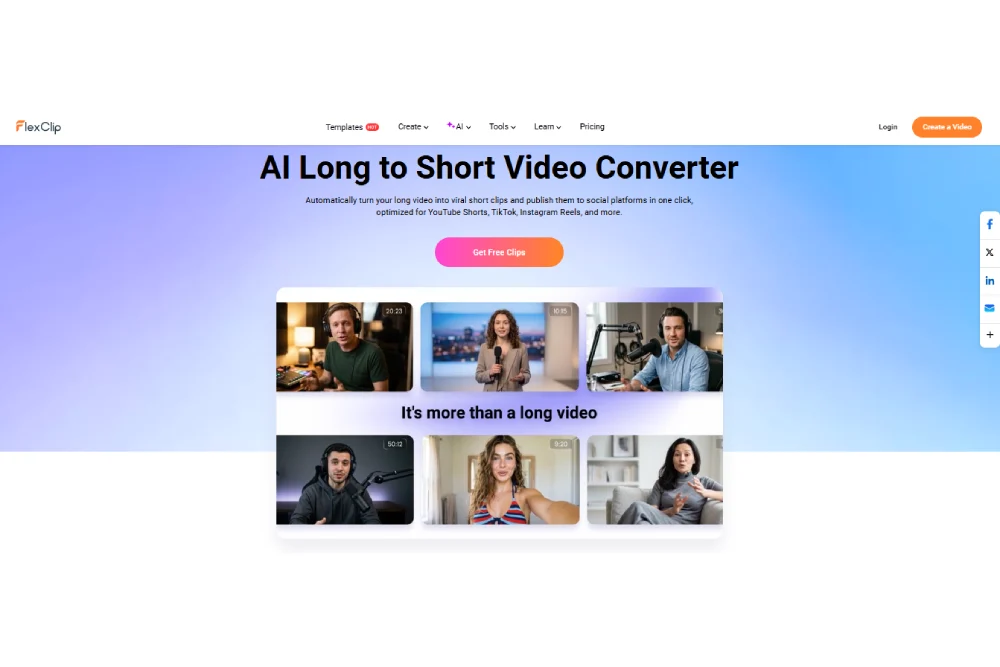
Creating long-form video content has never been easier. Repurposing it, however, is another story.
Podcasters record hour-long conversations every week. Businesses host webinars packed with useful information. YouTubers upload tutorials, interviews, and live streams regularly. But in today’s algorithm-driven social media landscape, long videos alone rarely maximize visibility.
What actually drives reach in 2026 is short-form distribution.
TikTok clips, Instagram Reels, YouTube Shorts, LinkedIn snippets, Vertical teaser videos.
The problem is that turning one long video into ten or twenty short clips traditionally requires a huge amount of editing time. Reviewing footage, identifying key moments, adding captions, resizing frames, and formatting content for mobile platforms can easily consume more hours than creating the original video itself.
This is exactly the challenge AI-powered tools like FlexClip are trying to solve.
Its AI Long Video to Shorts feature focuses on helping creators automatically transform long-form content into ready-to-publish short videos using artificial intelligence. But after spending time testing the platform, the more interesting story is not just what the AI can do — it is how much creative workflow friction the tool removes.
Table of Contents
From Manual Editing to AI-Assisted Workflows
Traditional editing workflows were built for a different era of content production.
A few years ago, creators mainly focused on producing polished long-form videos. Today, every piece of content is expected to exist in multiple formats simultaneously:
- Full-length video
- Vertical short clips
- Captioned social snippets
- Promotional highlights
- Mobile-first edits
This has changed editing from a creative process into a scalability problem.
FlexClip approaches this issue by combining AI automation with an accessible browser-based editor. Instead of forcing users through complicated post-production pipelines, the platform attempts to automate repetitive editing tasks while still allowing manual customization afterward.
That balance is important.
Many AI tools promise “one-click viral videos,” but in reality, creators still want control over pacing, branding, captions, and final presentation. FlexClip seems to understand that creators do not necessarily want AI replacing them — they want AI reducing tedious work.
What the AI Long Video to Shorts Tool Actually Does
The workflow begins with either uploading a video file or pasting a YouTube link.
Once the content is imported, FlexClip’s AI analyzes the footage and automatically extracts moments that are likely to perform well as short-form content.
The system is particularly effective with:
- Podcasts
- Interviews
- Tutorials
- Educational videos
- Webinars
- Commentary content
Rather than randomly cutting footage into small sections, the AI tries to identify conversational peaks, key statements, emotional moments, and attention-grabbing dialogue.
This matters because successful short-form clips are rarely about duration alone — they are about momentum and engagement.
The Editor Is What Makes the Platform More Practical
One of the biggest weaknesses in many AI clipping platforms is the lack of editing flexibility after automation.
Some systems generate clips but provide very limited customization options afterward. That creates frustration because AI-generated results are rarely perfect on the first attempt.
FlexClip takes a different approach by integrating a complete AI-powered video editor into the workflow.
After clips are generated, users can still:
- Adjust scene timing
- Edit captions
- Change aspect ratios
- Add transitions
- Insert branding
- Customize layouts
- Add music and effects
- Fine-tune visual elements
This transforms the platform from a simple AI clipping tool into a more complete editing environment.
For marketers and content teams, this is especially useful because brand consistency still matters even when content production becomes automated.
Vertical Video Optimization Feels Surprisingly Polished
A major issue with converting long-form content into Shorts is framing.
Horizontal video rarely translates naturally into vertical formats. Traditional editing requires manually repositioning subjects to keep speakers centered inside mobile-friendly layouts.
FlexClip automates much of this using AI reframing technology.
The platform can:
- Track active speakers
- Auto-center faces
- Create split-screen layouts
- Dynamically reposition framing
- Optimize composition for vertical viewing
The result feels significantly cleaner than the basic center-cropping found in many automated editors.
For podcast creators and interview-based channels, this feature alone can save hours of repetitive editing work.
Captions Are No Longer Optional
One area where FlexClip performs particularly well is subtitle generation.
Social video consumption has changed dramatically. Many users watch videos without audio during commutes, work breaks, or casual scrolling sessions. Captions are now directly connected to retention rates and viewer engagement.
FlexClip automatically generates animated subtitles synchronized with spoken dialogue.
The subtitles are:
- Mobile-friendly
- Customizable
- Visually engaging
- Suitable for social platforms
The platform also supports multilingual subtitle translation, which is valuable for creators targeting international audiences.
For businesses managing global campaigns, this can simplify localization workflows significantly.
Also Read:
Why Smarter Cyber Protection Is Becoming a Business Priority