
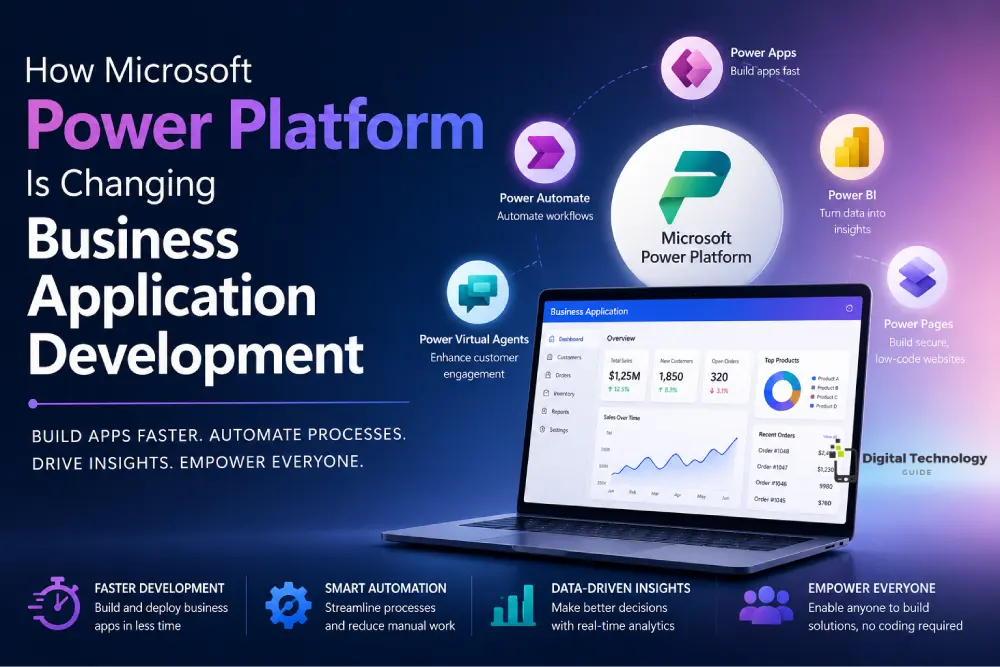
Application development isn’t measured by timelines and lines of code anymore; it’s measured by speed of delivery, agility and better business outcomes. Organisations have evolved past devoting months at a time to building/updating their internal applications. They now want time-to-value, at breakneck speed, and the ability to continuously adapt as their business changes.
Microsoft Power Platform is driving this revolution, and even Microsoft Power Platform developers recognise a shift in the creation, deployment, and management of business applications, with Power Platform speeding up development processes and minimising complexities.
Table of Contents
Low-code development platform
Microsoft Power Platform provides a low-code development platform that eradicates traditional application development bottlenecks. Teams are no longer required to build everything from scratch. There are hundreds of templates, connectors, data models, and components ready to be utilised and assembled into custom business apps. Ideas don’t have to sit in a backlog waiting to be developed. Low-code drastically reduces the time it takes to develop an application without compromising flexibility.
Empowering everyone to build apps
Microsoft Power Platform democratises who develops applications. IT used to be the only department that developed software applications. However, with low-code capabilities, business users, analysts, and operations teams work alongside IT developers to build solutions for themselves. Anyone in your organisation can build apps with Microsoft Power Apps – no coding required.
Speeds up application development
In the past, creating an application took months or longer. There were several steps that had to happen before seeing any results. Microsoft Power Platform drastically reduces application development time. Features like drag-and-drop, templates, Power Automate, and hundreds of connectors allow applications to be built in a matter of days. Also, with everyone involved in the development process, there is less back-and-forth and less information loss.
Integrated platform extends beyond Microsoft products
Not only can business users create their own applications in Microsoft Power Platform, but those applications can plug into almost every business application you use. Microsoft Power Platform connects Microsoft 365, Microsoft Dataverse, Dynamics 365 and Azure to thousands of third-party applications. Apps and workflows that span your business tools work together so users no longer have to switch between tools. Everything works together through Power Platform.
Building Applications with Integrated Data
Data is integral to any business application, which is why Microsoft Power Platform makes it easier to work with. Dataverse allows you to store your data in a database that knows about your business objects. The structured data is exposed to Power BI, where anyone can create beautiful dashboards and reports. Business managers don’t need to ask IT for weekly reports. You can see real-time data right at your fingertips instead of static spreadsheets.
Automating workflows within applications
So much of what teams do is repeatable work, and Microsoft Power Platform allows you to automate much of this work with Power Automate. From approval processes to sending notifications, workflows can be automated quickly, allowing everyone to focus on more important work. You can even integrate different applications together to pass data and trigger workflows. Eliminating repetitive tasks not only saves time but also reduces human error.
Building apps that scale with your business
Developing an application that needs to be rebuilt every time your business grows is common with traditional development. With Microsoft Power Platform, your applications will scale with your business. Whether you’re processing more data, scaling out to support additional users or adding increasingly complex functionality, the Power Platform is built to scale with you.
Security and compliance are built into every app
Security and compliance are built into every app with Microsoft Power Platform. Built-in controls give you peace of mind with advanced security and governance capabilities. Role-based access can simplify your access control. Secure your confidential data and stay in line with internal policies by leveraging Microsoft’s native security measures and mapping them to your existing security infrastructure.
Centralised governance lets you stay on top of things
Stay in control of applications, data and workflows across your organisation with centralised governance. Visibility into usage and policies through Microsoft Power Platform enables administrators to govern at scale and keep things running smoothly as everyone builds and deploys apps without slowing anyone down. Centralised governance means everyone can move fast and stay compliant, secure and aligned with your business standards.
Focus on continual improvement, not projects
Application development is moving from project-based to continuous improvement. With Microsoft Power Platform, you can update your applications and deploy them immediately without impacting your whole application. Continuous improvement means finding opportunities to enhance your applications everywhere, rather than on planned projects.
Committing to innovation
Another shift we are seeing is the ability to innovate faster. Microsoft Power Platform allows teams to prototype an idea in minutes, test how it works in real-world usage, and scale it when ready. Innovating doesn’t need to be expensive or risky. Use Power Platform to test your ideas first.
Business application development doesn’t have to be daunting. Partnering with a web development agency in Melbourne can help drive your digital transformation efforts while keeping long-term objectives in mind.
Also Read: